

When a Simple Interview Becomes a Storm
How a straightforward profile of a councilman collided with politics, projection, and my own recovery.

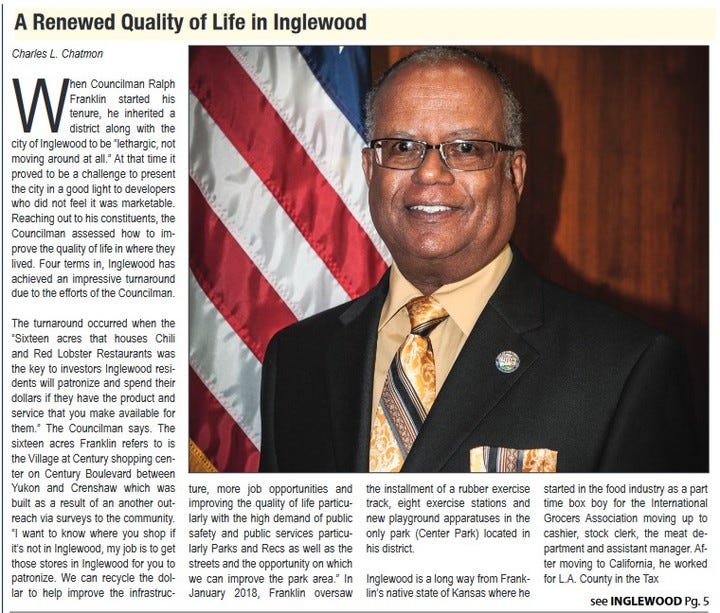
There are times when a piece of writing leaves your hands quietly, without drama or expectation. My interview with Councilman Ralph Franklin (California Crusader News, August 16-28, 2018) was one of those pieces, or so I thought. It was a straightforward civic profile, the kind of community‑centered journalism I’ve always believed in: ask honest questions, listen carefully, and let the subject speak for themselves.
But life has a way of adding weight to moments you thought were light.
I wrote that interview not long after my father passed away. Grief was still fresh, still sharp, still rearranging the way I moved through the world. Writing, for me, has always been a way to steady myself, to find order in the middle of emotional disarray. So I approached the Franklin piece the way I approached most assignments: with focus, with professionalism, with the belief that the work could stand on its own.
But once the article ran, it didn’t stay simple for long.
Local conservative bloggers picked it up almost immediately. They had their own long‑standing issues with the councilman, their own narratives about Inglewood’s redevelopment, and their own suspicions about anyone who wrote about him in anything other than a critical tone. Suddenly, a piece I wrote with no agenda became a Rorschach test for other people’s politics.
To them, the interview wasn’t journalism.
It was alignment.
It was an endorsement.
It was a signal, even though the only thing I intended to signal was that a public servant had something to say.
The irony, of course, is that Franklin himself delayed the interview before publication so he could review it. But irony rarely survives the political filter. Once people decide what a story means, they stop reading what it actually says.
And then, not long after the interview ran, my body gave out.
The stroke hit.
Suddenly the world narrowed to hospital rooms, doctor’s orders, and the slow, humbling work of recovery.
So the noise around the interview felt louder than it should have. Not because the criticism mattered, but because I was already carrying so much. Grief had already hollowed out a space inside me. The stroke had already shaken my sense of stability. When you’re healing, from loss, from illness, from the shock of your own vulnerability, even small conflicts feel oversized. Even misunderstandings feel heavier. And even the work you’re proud of can feel like something you need to defend.
Looking back, I realize the reaction to the article was never really about me. It wasn’t even about the writing. It was about the political weather of the moment, the way people read motives into everything, the way civic conversations get swallowed by suspicion, the way local journalism becomes collateral in battles it never intended to join.
But I also learned something valuable:
When you’re healing, you have to protect your peace, even from the noise that comes disguised as engagement. You have to choose what deserves your energy and what doesn’t. And sometimes, the most important boundary a writer can draw is the one that says, I’ve done my job. The rest is not mine to carry.
The interview stands on its own.
The noise has faded.
And I’m still here; writing, recovering, grieving, and learning to let the work speak for itself.
Charles L. Chatmon writes from the heart of Los Angeles, weaving poetry, commentary, and lived experience into stories that honor the communities that shaped him. His work has appeared in local newspapers and magazines, and he continues that tradition here, one reflection at a time. You can find more of his writing at charleslchatmon.com